Retail marketing is the branch of marketing that retail companies use to support their own locations and dealers in successfully marketing products and services to a local target audience.
- Goal: consistent marketing and brand image across all locations, combined with locally relevant offers and promotions
- Participants: the company's central marketing department (strategy, pricing and promotional guidelines, materials) and the individual dealers
- Biggest challenge: implementing price promotions and mandatory disclosures in a legally compliant and uniform manner across all locations while still enabling local marketing
- Central tool: a retail marketing system that provides materials and content centrally while allowing for local customization
What is retail marketing?
Definition and basics
Retail marketing refers to the entirety of marketing strategies and measures used by retail companies and manufacturers to bring their products to the end customer locally. At its core is sales marketing, which aims to encourage customers to purchase through the precise presentation of products and offers. Since most retail companies and manufacturers reach their customers not just at one, but at many locations, retail marketing is closely linked to local marketing in practice.
What is local retail marketing?
Local retail marketing describes the implementation of central brand guidelines at the level of an individual retail location or dealer. While the headquarters or the manufacturer provides the overarching strategy, pricing guidelines, and materials, the respective location ensures that these become relevant for their own region through local offers, location-specific promotions, or regional advertising campaigns.
Examples of local retail marketing:
- Location-specific offers and product range focuses
- Local landing pages and Google Business Profiles for each location
- Regional social media posts about promotions and events
- Adapting window displays and in-store advertising to local target audiences
Retail marketing: who is responsible for what?
In retail companies with multiple locations and dealers, the division of marketing responsibilities is usually clearly defined:
Headquarters' responsibilities:
- Developing brand strategy and corporate design
- Setting pricing and promotional guidelines (including mandatory disclosures)
- Providing centralized marketing materials and templates
- Planning seasonal and national campaigns
Dealer responsibilities:
- Local implementation of initiatives and campaigns
- On-site product presentation and store layout
- Managing local marketing channels (Google Business Profile, local social media presence)
- Providing feedback to headquarters on regional needs and results
Retail marketing goals
Key goals in retail marketing include:
- Acquiring new customers at every single location
- Long-term customer loyalty through communication and service
- Securing market share in a competitive environment
- Consistent brand image across all locations and retailers
- Increased revenue by boosting sales figures
Challenges in retail marketing
Price promotions and legal compliance
One of the most critical aspects of retail marketing is that strike-through prices, MSRPs, energy labels, and promotional periods are often subject to strict legal requirements depending on the industry. These must be implemented correctly and consistently across all locations for every price promotion. Adhering to these points is particularly important for the communication of a manufacturer or brand. In this regard, retail companies rely on the support of their local locations.
Rolling out seasonal campaigns simultaneously across many locations
Retail companies frequently work with seasonal promotions and changing campaign periods in their marketing. Ideally, these should start and end at the same time across all locations, including all associated measures such as window posters, flyers, social media posts, and newsletters. Here, too, the support of retailers is essential.
Competition against online retailers and comparison portals
Brick-and-mortar retail is in constant competition with online providers and price comparison portals that show customers alternatives with just a few clicks. To hold their own, retail companies must support their locations in communicating local advantages—such as personal advice, immediate availability, or local presence—in a visible and convincing way, while clearly highlighting the unique benefits of retail shopping.
Consistent brand identity despite local variations in product range and offers
Not every location carries the exact same product range or runs the same promotions. Regional differences in demand, inventory, or target audiences are normal and even desirable. The challenge lies in maintaining consistent communication and brand identity without overly restricting local flexibility.
Successful retail marketing strategies
Multi-channel campaigns
Combining print (e.g., flyers, posters), online marketing, social media, and in-store advertising allows retailers to reach customers across various touchpoints. This enables a campaign to be deployed across multiple channels simultaneously, thereby achieving greater reach.
Local SEO and visibility in map services
A fully maintained Google Business Profile for every location, consistent contact details, and location-specific landing pages ensure that customers can actually find the right store nearby. Especially when competing with online retailers, this local visibility is a decisive success factor for brick-and-mortar businesses.
Store design and in-store product presentation
How products and items are presented in-store significantly influences purchasing decisions. Clear guidelines on store design and product presentation (provided by manufacturers), while allowing for some local flexibility, help locations create a consistent yet engaging shopping experience.
Plan campaigns centrally, roll them out locally
A central marketing calendar ensures that every location knows which promotion is running and when. A complete package of materials is provided for each campaign, which locations can adopt directly and deploy locally. This allows products and promotions to be rolled out optimally at the local level, boosting company-wide sales.
The retail marketing system:
Software as the backbone of collaboration
The more locations a retail company operates, the harder it becomes to coordinate marketing manually, especially with legally sensitive price promotions and tightly scheduled seasonal campaigns. A specialized retail marketing platform provides the necessary structure within the company.
Core functions of a retail marketing system:
- Digital Asset Management: central provision of images, graphics, price templates, and promotional templates
- Web-to-Print: direct personalization, ordering, and production of print materials from a single platform
- Legally compliant price templates: strikethrough prices, RRPs, and mandatory disclosures are hard-coded into the template; locations only edit the designated fields
- Central marketing calendar: plan and roll out seasonal promotions, items, and campaigns consistently across all locations
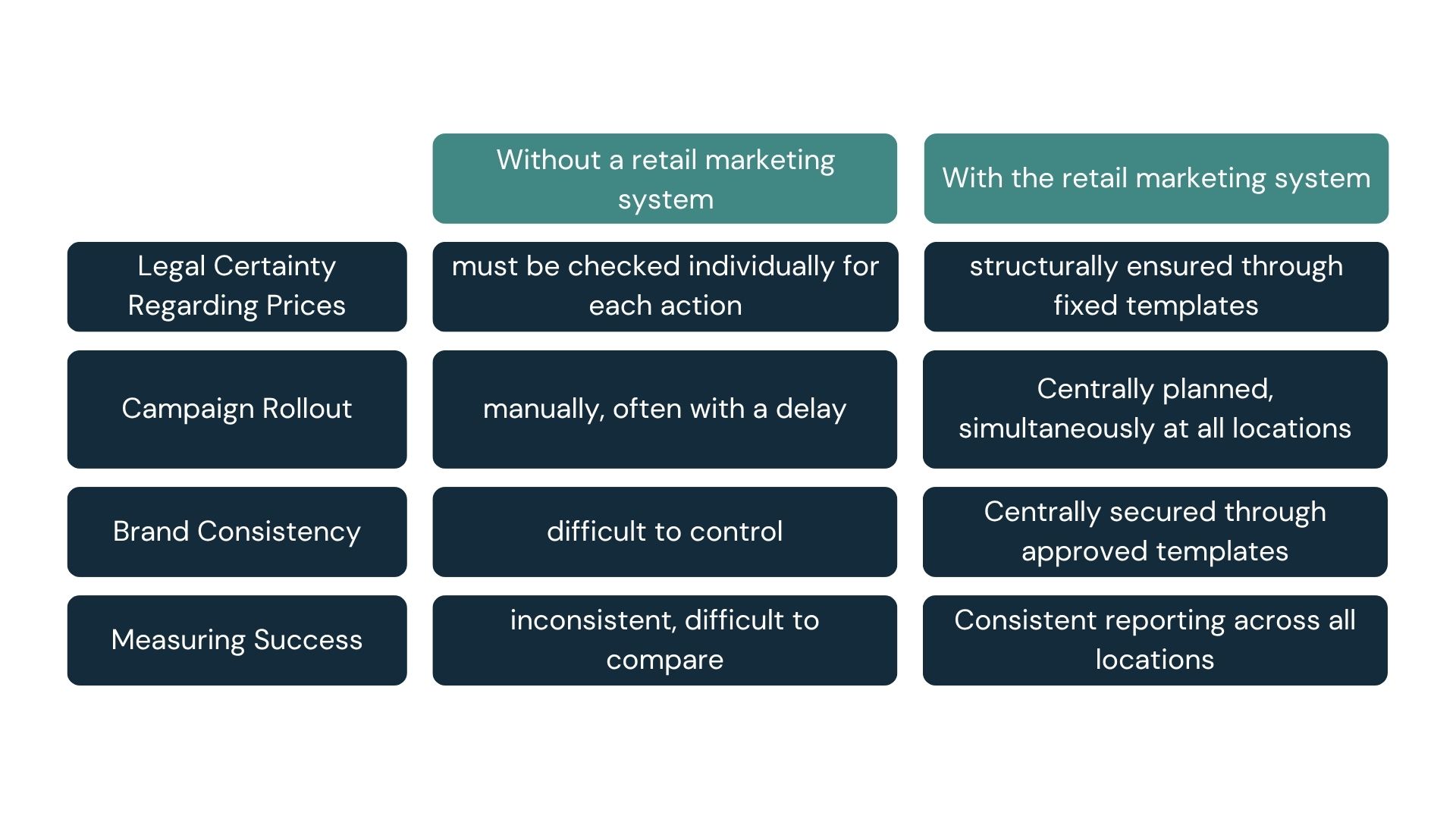
A well-implemented retail marketing software significantly reduces both the legal risk associated with price promotions and the manual coordination effort.
Unlock the full potential of your marketing
How does a retail marketing system ensure accurate pricing and mandatory disclosures?
With such a platform, the company can centrally store strike-through prices, RRPs, and promotional periods, locking them firmly into the template. In the editor, only the designated fields—such as addresses or regional additions—can be edited, ensuring that every piece of advertising material remains legally compliant from the moment it is personalized.
How can promotional pricing be rolled out across all locations simultaneously?
Seasonal and promotional campaigns are planned via a central marketing calendar, ensuring every location knows exactly when each campaign begins. The complete package of materials is available directly with the campaign, and reporting tools allow you to track which locations and retailers have already implemented it.
What defines an effective trade marketing system?
The hallmarks of a great platform are the combination of centralized control and local flexibility: it provides legally compliant templates from a central source, enables individual locations to customize content independently while remaining on-brand, and delivers cross-location reporting to measure success.
How can retail companies compete with online retailers?
By consistently highlighting their local advantages—such as personalized advice, immediate availability, and a physical presence—through well-maintained Google Business Profiles, local landing pages, and the swift, uniform execution of promotions at every location. This is how brick-and-mortar retail remains visible and relevant to customers in the region.