

Outdated logos on flyers, marketing materials sent back and forth via email, locations running campaigns independently and deviating from corporate design. These are challenges that marketing headquarters in franchise systems, retail organizations, and decentralized companies face every day.
The more locations you have, the harder it becomes to ensure brand consistency and local visibility at the same time. Marketing Asset Management software resolves this tension and creates the operational foundation to keep local marketing centrally controllable.
What is Marketing Asset Management?
Marketing Asset Management (MAM) refers to the systematic management, control, and distribution of all a company's digital and physical assets. This includes logos, image templates, campaign templates, videos, content, and print materials.
MAM is often equated with Digital Asset Management (DAM) However, the difference is crucial:
A DAM is primarily a digital library that stores assets in a structured way. Marketing Asset Management goes further: it actively controls which assets can be used, adapted, and deployed by whom, while ensuring clearly defined workflows and approval processes for all stakeholders.
MAM connects three levels:
- Management: Which assets are in storage, in what version, and with what approval status?
- Control: Who is authorized to use, edit, or publish which assets?
- Distribution: How do the right assets reach the right locations and teams at the right time?
The typical challenges of decentralized companies
In decentralized companies such as franchise or retail organizations, similar structural problems often arise:
Brand consistency versus local flexibility
Headquarters wants the brand to look the same everywhere. Local sales partners want to communicate their own offers, opening hours, and locations. Both are valid, but enabling both simultaneously is nearly impossible without the right structures and a suitable tool. The result: local teams act independently and outside of brand guidelines.
Version chaos and asset confusion
Without a central platform and a structured filing process, parallel worlds quickly emerge. Files are passed from hand to hand via email or messenger, outdated logos appear on flyers, and restricted campaign motifs continue to be used because no one knows any better. Even experienced marketing teams lose track of the current status of their assets this way.
High coordination effort for headquarters
When local sales partners have to submit a request for every adjustment, the central marketing team becomes a bottleneck. Instead of working strategically, they spend their time answering requests, sending out assets, and correcting errors. The more locations and partners involved, the more confusing and time-consuming the work becomes for all teams.
Compliance and CI risks
Unauthorized assets are not just an aesthetic problem. In regulated industries, incorrect statements or missing mandatory information can have legal consequences. And even without a legal dimension, materials that fall outside the corporate identity permanently weaken the brand's image and recognition value.
What does a Marketing Asset Management system do?
Professional MAM software is more than just digital storage. It is the platform that connects headquarters and local partners so that both can act efficiently without working against each other. An overview of the most important features:
Central library with a clear structure
All approved assets are located in one place on a shared platform. Every user, whether in the central marketing department or a local franchisee, accesses the same up-to-date storage. No outdated file versions, no uncertainty about whether the logo being used is still valid.
Template management with targeted personalization scope
Headquarters defines the framework layout: colors, fonts, logo placement, and mandatory content. Within this framework, local teams can specifically add individual content. Whether it's their own location name, a regional promotion, or a local phone number.
The result: creative materials that are both brand-compliant and locally relevant, without headquarters having to check every single process.
Workflows, approvals, and rights management
A MAM system maps differentiated role concepts: Who is allowed to edit templates? Who is allowed to download assets? Who must grant approvals? Workflows can be configured so that sensitive assets are checked before output. Less critical materials pass through without an approval loop so that teams at the locations are not slowed down.
Multichannel output from a single source
Today, a campaign template must work for print, digital ads, social media, and email. MAM software enables the output of the same asset in different formats and offers editable templates for a wide variety of channels. This saves time, avoids errors during manual post-processing, and ensures consistent communication across all teams and channels.
Campaign management for the sales partner network
Beyond mere asset management, modern marketing portal platforms enable the management of local campaigns within centrally defined guardrails. Teams at the locations can select, customize, and directly commission or publish promotions without having to go through headquarters. This continues to work even as the network and the number of sales partners grow.
Marketing Asset Management vs. Digital Asset Management
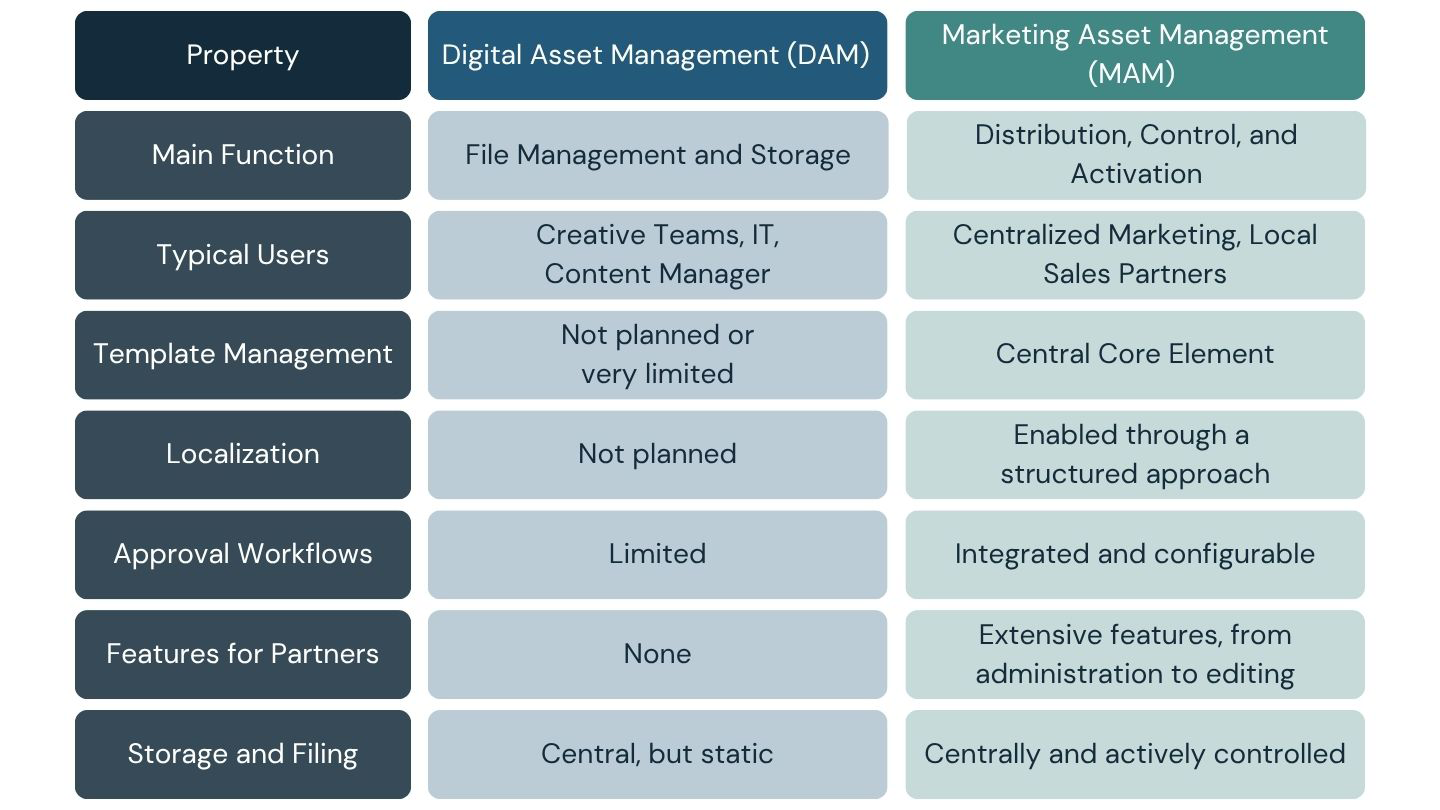
A DAM is the right choice if your primary goal is the structured storage and retrieval of digital assets. A Marketing Asset Management system is the right choice when you need to empower marketing teams and sales partners to execute simple, effective local marketing.
Why Marketing Asset Management is particularly relevant for decentralized organizations
Decentralized companies like franchises and retail organizations share a structural characteristic: marketing expertise and marketing responsibility are separated. The expertise lies with headquarters, while the responsibility for local implementation lies with the local sales partner.
Traditional solutions include email distribution lists, shared cloud folders, and PDF manuals. However, these only delay the problem or, in the worst case, create new challenges for all teams involved.
A central platform with integrated Marketing Asset Management creates the foundation that both sides need:
- Headquarters retains control over the brand, content, and quality of all assets.
- Sales partners gain easy access to ready-to-use assets and the ability to customize them within defined parameters.
- Both teams work on the same platform with the same data.
What should you look for when choosing MAM software?
Not every platform on the market is equally suitable for decentralized companies. These criteria will help you evaluate your options:
User-friendliness for non-technical users
Franchisees or branch managers are not marketing specialists. The tool must be intuitive enough for teams without a marketing background to work with it independently.
Role-based access control and permissions management
Can you granularly control who can see and edit what? Can you assign different permissions to various teams and sales partners (e.g., based on region or company size)?
Template engine: Balancing flexibility and brand protection
How much leeway does the platform allow for local customization? Can you, as headquarters, clearly define which features and assets are locked and what can be modified?
Integration capabilities
Can the platform be connected to existing systems? Can CRM, PIM, or existing digital and print service providers be integrated?
Scalability
What works for ten locations doesn't necessarily work for three hundred. The platform should scale technically and financially with your network of sales partners and enable local marketing for everyone.
Support and onboarding
Decentralized rollouts are complex. Check whether the provider actively supports local partners during onboarding and which features are available for this purpose.
MAM system in local marketing
Marketing Asset Management is not just an add-on for large marketing departments. It is the operational foundation that ensures local marketing in decentralized companies is consistent, fast, and brand-compliant.
Anyone still relying on email distribution lists and shared drives is losing brand consistency and local potential every single day. By switching to a centralized software with integrated Marketing Asset Management, you give headquarters control over all assets while providing local teams with the autonomy they need to become truly active in their local marketing efforts.
Would you like to learn how this can be implemented in your company? Book a demo.
Unlock the full potential of your marketing
What is Marketing Asset Management?
Marketing Asset Management refers to the systematic management, control, and distribution of all a company's assets: from logos and image templates to campaign templates and digital content. Unlike a pure DAM, a MAM system actively controls which teams are allowed to use and customize which assets.
What is the difference between Marketing Asset Management (MAM) and Digital Asset Management (DAM)?
A Digital Asset Management system (DAM) focuses on the structured storage and findability of digital content. Marketing Asset Management goes further: it actively controls who can use, customize, and publish which assets, and also offers template management, workflows, and features for decentralized teams and companies. A DAM system is the first step, while MAM software provides comprehensive coverage for local marketing.
Who is Marketing Asset Management software suitable for?
It is particularly relevant for companies with decentralized structures: franchise systems, retail organizations, and chain stores that want to manage local marketing from a central platform while involving various partners and locations.
What are the most important functions of Marketing Asset Management software?
A central asset library with structured storage, template management with room for local personalization, configurable approval workflows, rights management for sales partners, and multi-channel output for print, digital, and social media. Modern platforms also offer features for campaign management and brand management.


