
Four Pillars for Strong Local Brand Leadership
Delayed approvals, inconsistent advertising campaigns, locations implementing marketing differently, social media presences without a clear strategy, or local teams that could be visible but get lost in day-to-day operations.
Challenges that most companies with branches, distribution networks, or franchise structures are all too familiar with.
The more brands grow, the harder it becomes to centrally manage local visibility. While customers expect regional relevance and a personal approach, marketing departments often struggle internally with manual processes, lack of scalability, and insufficient transparency.
The result: inconsistent brand presences and enormous untapped local potential.
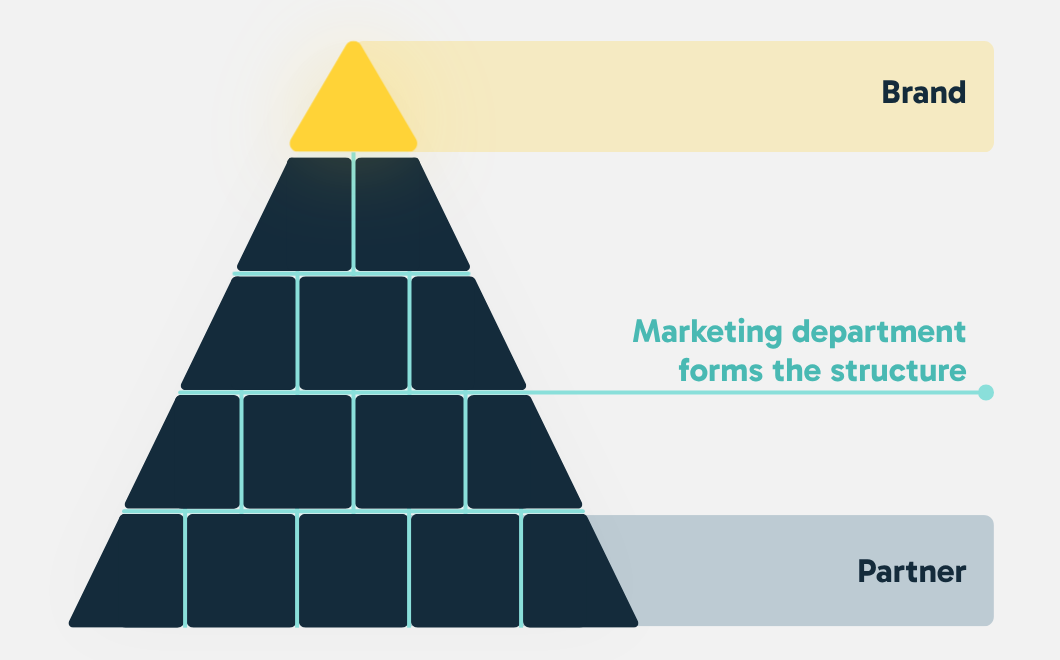
The Pyramid: Many Locations. One Structure. Maximum Impact.
Sustainable visibility in 2026 won't happen by chance, but brick by brick.
The Foundation is formed by local sales partners, branches, franchisees, and locations – in other words, the very people and teams who create customer proximity daily and bring brands to life. This is where reach and trust are built.
For many individual measures to result in a consistent brand impact, there needs to be a stable structure: the marketing headquarters. It provides guidance, defines brand standards, develops campaigns, provides tools, and connects local activities into a cohesive overall picture.
And at the top is what everything contributes to: the brand itself. Visible from afar, instantly recognizable, and firmly rooted in the trust of potential customers.
Your brand will only be strongly perceived if the entire pyramid is built stably, from the local foundation and strategic control to the collective brand impact.
Decentralized strength needs a stable foundation.
The marketing pyramid thus represents:
- a strong brand with a clear identity
- central structures that enable scaling
- local teams that create proximity and visibility
- Collaboration instead of isolated individual actions
Four building blocks of a stable marketing pyramid
1. A stable foundation starts with simple processes
Many local teams fail not due to lack of motivation, but due to overly complicated processes.
Successful companies therefore create simple systems:
- central templates instead of individual design
- clear approval processes
- campaigns that can be adapted locally
- few tools instead of many individual solutions
The simpler local marketing measures are to implement, the more frequently they are used in a targeted manner.
2. Structure instead of rigid control
Local markets operate differently. What works in a major city doesn't automatically guarantee regional success.
Strong brands therefore create a framework:
- defined brand guidelines
- central campaign logic
- local customization options for content, offers, or target audiences
This keeps the brand consistent without losing local authenticity (and target audience appeal).
3. To scale, impact must be measurable
Many companies invest in local marketing but often have little insight into which locations are active, which measures are effective, and where potential remains untapped.
Successful organizations are data-driven:
- with dashboards
- clear KPIs
- comparability between locations
- transparent reporting structures
Only measurable visibility can be scaled long-term.
4. The foundation supports the entire brand's impact
Local teams are not merely an extension of headquarters; they are on-site brand ambassadors.
Companies that actively involve their sales partners often benefit from:
- higher brand identification
- faster campaign implementations
- more local content
- stronger customer loyalty
Significant brand impact rarely originates solely from headquarters. It emerges where people make the brand visible every day.
For individual local initiatives to achieve a strong overall impact, clear structures, simple processes, and local teams actively championing the brand are essential. This is precisely how sustainable local visibility is created, which can then be consistently developed across multiple locations.


