

The number of communication channels is constantly increasing, particularly in the digital sector. However, digitization is not just creating new media channels. In marketing and communication, it also enables the tailor-made creation of printed or digital advertising material and its targeted distribution from the recipient's point of view.
On the one hand, this article looks at the various forms of personalization and individualization in the distribution of advertising material. In addition, the different variants of including target group parameters in the technical creation of advertising material are analysed.
The database
The database for target group parameters as well as advertising material content can be made up of a wide variety of sources:
Databases: Media, product and customer databases, content management or enterprise resource planning (ERP) systems.
Internet platforms: Web shops and websites, web analysis systems, apps or social media channels.
External data services: Address and household databases, market research or marketing data.
Real time data: Weather and time of day data, location, or device information.
The data is either maintained and collected ourselves (“first-party data”) or obtained from data service providers (“third-party data”).
The audience parameters
With the help of target group parameters, their analysis and evaluation, the content of advertising material can be adapted to the target groups or delivered to the right interested parties. The term “target group” is broadly defined here and can also include an individual person. Accordingly, the advertising content is personalized and tailored to a recipient or contains further target group-specific individualizations.
Examples of audience parameters: Customer or prospect, women or men, areas of interest, purchasing power, purchasing activities, geographical location and time of day information.
For example, address databases can provide advertisers with addresses that have a specific gender, selected interests, and defined purchasing power. But login-protected environments, such as online shops or social media platforms, also provide features that can be precisely assigned to individual people. In this way, expected needs can be inferred based on buying behavior or activities.
The target group parameters can influence advertising content in various ways, such as the depiction of cosmetic products in a drugstore mailing for female addressees. In other cases, the target group information is only used for distribution, for example the distribution of a furniture store brochure as part of a direct mail to specific households.
Advertising material and media channels
Target group determination (English: targeting) and the implementation of advertising campaigns are part of marketing's core business. Advertising measures for specific products or events are managed in parallel in several media channels. One example of this is Aldi's emoji campaign, which featured the “edible faces” on large format posters, city light posters, digital outdoor advertising space, as advertisements in daily newspapers and in grocer brochures as well as on the Aldi website.
This example can also be used to illustrate the distinction between the terms “media channel” and “advertising medium”: An ad as an advertising medium can appear in daily newspapers and magazines in the media channels. The content in the advertising media includes address data, article data, images, video and audio files, or even real-time data, such as weather or time of day.
Networking and retargeting
In “networked” campaigns, the advertising impact should be reinforced by linking media channels together in order to guide users from one channel to another and trigger actions from interested parties. Typical scenarios from the automotive sector include online ads on the Internet, which are linked to the websites of local car dealers, where test drives can be booked. The success of such a campaign can clearly be measured based on the number of test drives booked.
The advertising material should be displayed, distributed and used where the target group can best be reached. In the digital sector, so-called “retargeting” is also used for this purpose. Retargeting, for example, shows customers content on websites based on their previous activities, which is assumed to be relevant to buyer behavior. This principle can also be transferred to the print sector if, for example, personalized printed brochures take consumer behavior in online shops into account and are included with shipments of goods.
The following three variants describe basic methods of creating advertising material and can also be used in combination. The term “personalization” used here also includes the target group-specific “individualization” in the content design of advertising materials.
Option 1: Unpersonalized advertising material creation
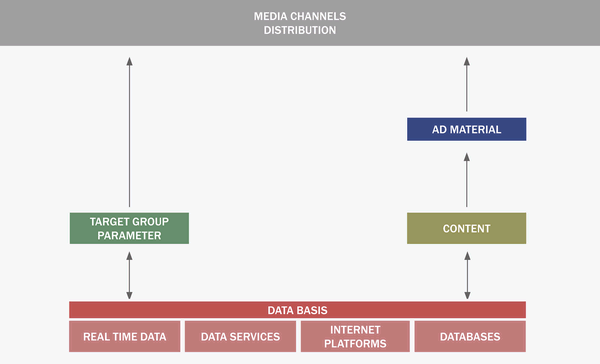
In this variant, advertising material is created without extensive content personalization or individualization. Media production is either automated, partially automated or manually based on databases, possibly by integrating export files from databases. Examples include brochures from furniture stores, hardware stores, electronics stores or advertisements.
In parallel, desired target groups are selected, for example using address service providers, household databases or special marketing data. The advertising material is then directed to these target groups, for example offline via direct mail, mailings addressed by post, as supplements in newspapers or digitally in the form of online ads on websites or in social media channels.
Option 2: Partially personalized advertising material creation
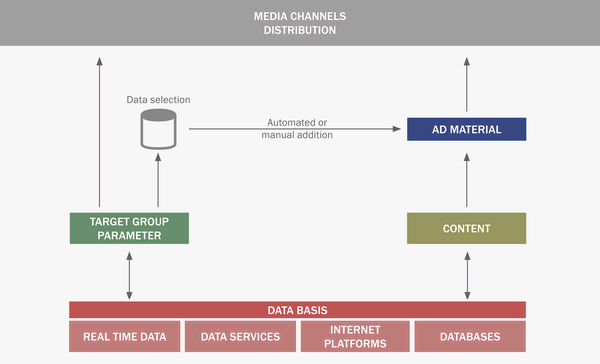
The unpersonalized advertising material can be partially personalized or individualized, for example through digital printing or in marketing portals from brand companies. Corporate design-compliant templates are usually created in an impersonalized way and branches, branches or sales staff complement individual data in the marketing portal in the form of contact details, regional offers or prices.
Examples include flyers from insurance companies or bank branches that supplement regional data, or online ads that are also supplemented with regional data and are displayed live in a specific regional area.
Option 3: Fully personalized advertising material creation
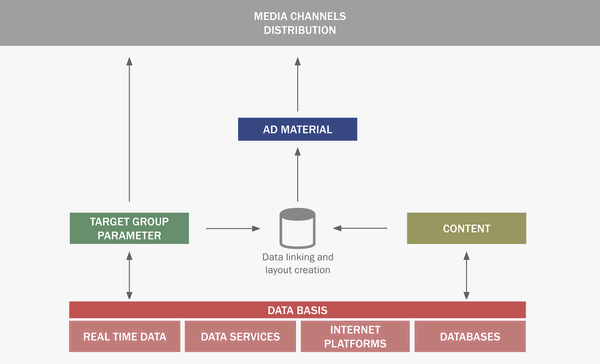
In this variant, the advertising material is largely created automatically based on target group parameters and personalized and individualized content.
Websites are personalized or individualized in this way, for example by using the IP address to determine location data and displaying local offers or contact details of branches and branches. Suitable content can also be derived from the information about the types of devices used, i.e. whether a desktop PC or mobile device is being used, or whether it is a new visitor and the click behavior.
In the print sector, solutions are becoming established that can be used to create fully personalized package or catalog inserts and mailings. This can be based on various data sources, such as from customer relationship management (CRM), enterprise resource planning (ERP) systems and so-called recommendation engines. These are software solutions that are integrated into online shops and analyze buyer and user behavior. The results make it possible to deduce which products buyers are interested in and which products are likely to be of interest in the future.
The customer and product data is then combined, linked to layout templates in an automatic process, digitally printed and delivered to recipients — either together with a shipment of goods or in the form of print mailings.
In this process, target group parameters and the advertising medium itself are brought to an almost 100 percent match.
conclusion
Digitalization makes it possible to design and deliver advertising material and media channels in a differentiated and highly targeted manner. However, there are also considerable challenges to overcome: The structured structure and regular maintenance of data stocks as well as the intelligent linking of data sources require a relatively high level of conceptual effort. But then marketing campaigns can be implemented that tailor their messages to individual recipients. Competitive advantages are to be expected — through new customer acquisition, customer loyalty and higher sales.