Digital accessibility is no longer a niche topic. With the European Accessibility Act (EAA) new requirements for digital products and services have been in effect across Europe since 2025. The goal is to make digital offerings accessible to as many people as possible, regardless of individual limitations or how they are used.
For companies, this means that digital accessibility is increasingly becoming an integral part of modern digital communication. It is no longer just about public websites. Digital systems and tools used in everyday work should also be designed to be accessible. After all, digital processes only function truly efficiently when they are equally easy for all users to navigate.
Digital accessibility begins in the marketing process
Many companies think of their website first when it comes to digital accessibility. In reality, however, it begins much earlier.
Marketing teams and sales partners use a wide variety of applications every day to create advertising materials, implement campaigns, or publish content. If these systems are complicated to operate or have limited keyboard or screen reader functionality, unnecessary hurdles are created in the daily workflow.
Digital accessibility therefore improves not only accessibility but also the general usability of software. Clear structures, intuitive navigation, and consistent operating concepts make daily work easier for all users.
Digital accessibility creates added value for the entire sales partner network
Digital accessibility is not a topic that only affects individual users. In companies with branches, franchise structures, or sales partner networks, hundreds or even thousands of people—from marketing managers at headquarters to local staff—often work with the same marketing tools. Users rarely have the same background in terms of experience, technical equipment, or working methods, nor do they all have the same physical, sensory, or cognitive abilities.
An accessible platform ensures that all users can work efficiently, as independently as possible of their individual circumstances. This fosters acceptance, reduces daily hurdles, and strengthens sustainable collaboration between marketing headquarters and local teams. Support queries decrease, new users find their way around more quickly, and local marketing activities can be implemented more consistently across the entire network.
Digital accessibility as part of future-proof marketing software
Digital accessibility not only contributes to inclusion but also improves the quality of marketing processes. Intuitive user interfaces, clear structures, and consistent operation facilitate daily collaboration between marketing teams and sales partners.
Especially in large marketing networks, even small hurdles can lead to slower processes, increased support requirements, or marketing activities not being implemented as planned. Accessible marketing software reduces these hurdles and creates the foundation for higher acceptance across the entire network.
Our Local Marketing Platform is becoming even more intuitive
Against this backdrop, digital accessibility is a key quality standard for modern software. By further developing digital accessibility within our Local Marketing Platform, we are creating a solution that is easier and more intuitive for all users.
Specifically, we have further developed the platform in several areas:
- Optimized keyboard navigation for more complete navigation without a mouse.
- Improved focus indicators, so it is always clear which element is currently selected.
- Revised navigation and clearer instructions, which make it easier to find your way around the system.
- Expanded support for screen readers and other assistive technologies.
- Added alternative text for graphical content, so that information can also be read aloud.
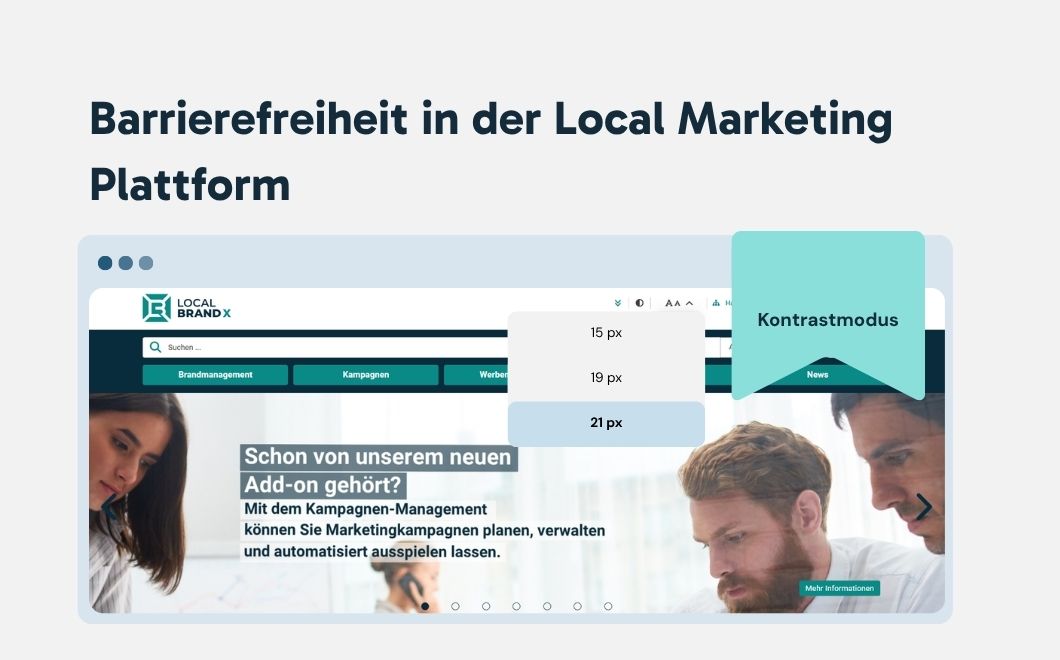
- Optimized contrasts and controls, to make content more perceptible and easier to use.
The Local Marketing Platform also allows you to centrally create and deploy accessible websites for individual locations. This makes it easier for companies to publish digital content that meets both brand guidelines and current digital accessibility requirements, making it accessible to the widest possible target audience.
The result is a marketing platform that actively supports digital accessibility while simultaneously increasing ease of use for all users.
Digital accessibility as an investment in the future
With the European Accessibility Act, digital accessibility is becoming increasingly important. Companies that adapt their marketing processes early on not only meet new requirements but also lay the foundation for more efficient collaboration, higher user acceptance, and digital communication that reaches as many people as possible.
Digital accessibility should therefore not be seen as an additional task, but as an integral part of modern marketing processes. Investing in accessible systems today creates the foundation for sustainable local brand management and a better user experience at every level.