Insurance marketing is the branch of marketing focused on promoting insurance products and services. Marketing is typically managed centrally by the insurance company and implemented locally by individual insurance agents. Key points at a glance:
- Goal: a consistent brand image across all locations, combined with locally relevant customer communication and advice
- Participants: the insurance company (brand strategy, materials, compliance requirements) and local insurance agents and partners (regional implementation, customer contact)
- Biggest challenge: maintaining regulatory compliance while simultaneously adapting marketing activities for local markets
- Central tool: an insurance marketing system that provides marketing materials centrally, consistently, and in compliance with regulations
What is insurance marketing?
Definition and basics
The insurance industry is generally concerned with protecting individuals and businesses against potential financial losses. This involves offering insurance products ranging from life and health insurance to auto and home insurance, or specialized coverage for businesses. Insurance marketing encompasses all marketing activities used by an insurance company to promote its products and services to the target audience and position the brand as effectively as possible.
Since most insurance companies do not serve their customers directly from headquarters, but rather through a multitude of local insurance agents, branches, and partners, insurance marketing in practice is always also local marketing. Headquarters defines the strategy, brand identity, and materials, while agents implement them for their respective regions and combine them with personal advice.
Insurance agents and partners as the local interface to the customer
Insurance agents play a central role in insurance marketing; they position the company's products and services locally, acquire new customers, maintain existing customer relationships, and thereby ensure the long-term growth and profitability of the company in their region.
This structure differs from classic branch or franchise models, but follows the same basic principle. Centralized brand management meets a decentralized, locally responsible sales unit. Just like with Branches or franchisees the close cooperation between headquarters and those responsible on-site is also the key to the success of the marketing strategy here.
What is local insurance marketing?
Local insurance marketing describes the implementation of central brand guidelines at the level of an individual location. Since insurance products often require intensive consultation and trust plays a decisive role, the local partner is particularly important here, as customers want a contact person in their region whom they can trust.
Examples of local insurance marketing:
- Regional offers tailored to local customer needs
- Local advertising campaigns for individual locations
- Presence at local events or community initiatives
- Personal, location-based communication via a wide variety of channels
Location marketing in the insurance industry
In addition to content-based local marketing, pure location marketing also plays an important role for insurance companies. In this context, the targeted visibility of every single location in local search results, map services, and directories is generally important. A fully maintained Google Business Profile for each location, consistent contact details, and location-specific landing pages ensure that potential customers can actually find the right contact person in their area. Especially for companies with many partners and locations, this area is often underestimated, even though it has a direct influence on acquiring new local customers.
Goals in insurance marketing
The central goals in insurance marketing include:
- Promotion of insurance productsthat meet the needs of the target audience
- Consistent brand image created across all locations
- Increased brand awareness
- Strengthen trust in the brand and the company
- New customer acquisition
- Revenue growth through increased sales figures
- Increase customer satisfaction
Challenges in insurance marketing
Meeting regulatory requirements
The insurance industry is subject to strict regulatory requirements: all marketing activities, advertising campaigns, and sales practices must comply with legal standards. In a local context, this means that insurance brokers must adapt their marketing measures to the specific legal framework of their region. Insufficient knowledge of these requirements on the part of representatives endangers not only the individual location but the brand image of the entire company. The central marketing department is therefore tasked with supporting representatives in the compliant local adaptation of materials and content.
Gaining and maintaining customer trust
Trust is the foundation of every customer relationship in the insurance industry. As the direct point of contact for the end customer, insurance representatives are responsible for communicating transparently and reliably, thereby conveying the company's integrity. Excellent customer service and fair, clearly understandable insurance terms are crucial for building this trust.
Staying competitive in an intense market environment
Insurance companies are competing not only with each other but increasingly with other financial service providers and technology firms offering innovative solutions. To differentiate themselves in this environment, comprehensive multi-channel campaigns are essential—such as a combination of social media ads, out-of-home advertising, and direct mail—to reach diverse target segments. Implementing such varied, local campaigns and content requires significant time and financial investment from headquarters. Furthermore, local agents often feel hesitant about new forms of marketing; it is therefore crucial to support them by providing easy-to-use content and templates.
Dependence on the marketing affinity of local agents
Insurance companies with many locations rely on their local agents to maintain a regional presence and build brand awareness. However, not every agent is equally marketing-savvy or motivated to independently implement local marketing activities and content. To ensure a strong local presence regardless, the marketing department must actively support its brokers in executing location-specific offline and online marketing measures, ideally with as little additional effort as possible for the individual agent.
Successful insurance marketing strategies
Cross-media marketing
The combination of offline strategies, such as print ads, radio spots, or direct mail, and online marketing measures like search engine optimization, social media ads, and email marketing has become a core component of successful insurance marketing. This marketing mix allows companies to reach more potential customers and increase brand awareness across multiple channels simultaneously. As a result, campaigns and relevant content reach a wider audience, potentially generating more leads and new customer contacts.
Personalization of offers and materials
Customers increasingly expect tailored insurance solutions that meet their individual needs. Local insurance brokers can meet this demand by creating personalized offers and running targeted advertising for their specific location. Furthermore, marketing content can be adapted to local customers and circumstances, thereby increasing its relevance.
Customer reviews and recommendations
Positive customer reviews strengthen the trust of potential clients and enhance the company's credibility. An excellent customer experience, combined with targeted incentives for reviews and the integration of review platforms on the company website, helps to attract new customers and increase the loyalty of existing ones.
Data analysis for more targeted campaigns
By analyzing customer preferences, purchasing behavior, and website interactions, insurance companies gain valuable insights into their target audience's behavior. This overview enables them to align marketing activities more precisely, address customers more effectively, and use their marketing budget more efficiently.
Existing Customer Marketing and Cross-Selling
Beyond acquiring new customers, nurturing existing relationships is economically vital for insurance companies. Targeted marketing to existing customers strengthens loyalty and unlocks additional revenue potential. Local insurance agents are uniquely positioned to do this, as they often have a deep understanding of their clients and their life situations—based on their current policies—allowing them to identify additional needs early on. By offering personalized advice or highlighting relevant supplementary products (cross-selling), agents can build stronger, more lasting customer relationships.
AI Visibility for Local Insurance Agencies
In addition to traditional search engine optimization, artificial intelligence and search via LLMs (ChatGPT, Gemini, etc.) are becoming increasingly important. How well an agency's content and offerings appear in AI-powered search assistants and response systems directly impacts new customer acquisition and potential sales. Providing complete, up-to-date, and structured location information increases the likelihood that an agency will be recommended in AI-generated responses, helping to attract new clients.
The Insurance Marketing System: Software as the Backbone of Collaboration
Coordinating and executing marketing strategies across multiple locations is a complex task, especially given the industry's regulatory requirements. A specialized insurance marketing system provides the necessary structure by centralizing marketing assets and content, simplifying the planning and management of all campaigns, and ensuring that local adjustments remain within brand guidelines and regulatory boundaries.
Core functions of an insurance marketing system:
- Digital Asset Management: centralized provision of content, images, graphics, and videos
- Centralized Campaign Planning: planning, management, and control of all marketing campaigns in one place
- Compliant local customization: agents can adapt approved content and materials for their location without violating brand guidelines or regulatory requirements
- Analytics tools: Evaluation and optimization of local marketing campaign performance
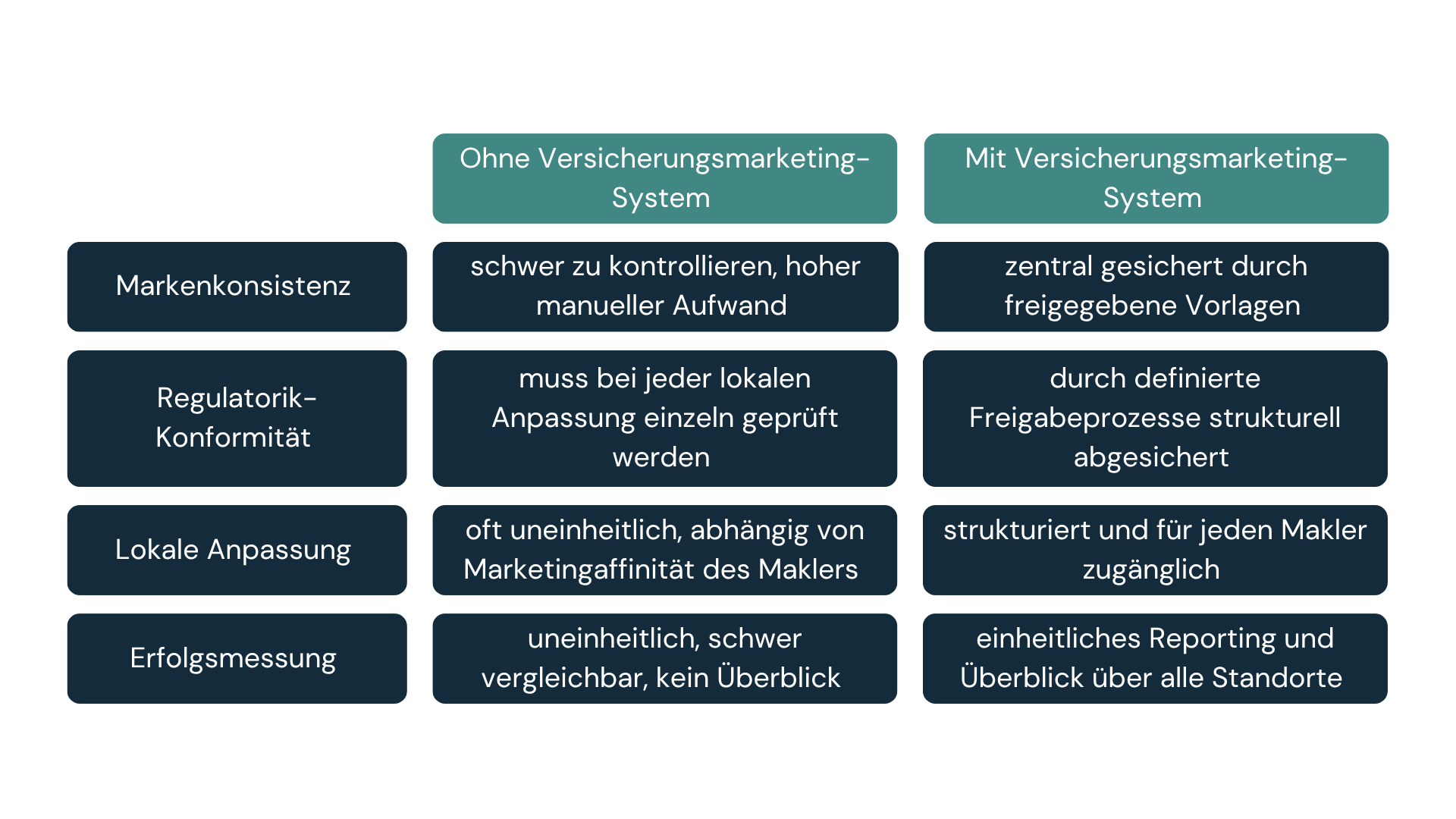
Such a insurance marketing softwaresolution generally and significantly contributes to improving coordination between insurance companies and brokers, maintaining consistent brand presence, and sustainably strengthening the company's overall marketing success.
Unlock the full potential of your marketing
What sets insurance marketing apart from marketing in other industries?
Generally, the biggest difference lies in the heavy regulatory influence. Marketing activities, advertising campaigns, content, and sales practices must comply with strict legal requirements, which can also vary by region. Furthermore, insurance products require extensive consultation, and trust plays a particularly significant role in the purchasing decision.
Who is responsible for compliance with regulatory requirements in local marketing? The company or the representative?
In practice, both sides share responsibility. The insurance company must provide compliant marketing materials and clear guidelines, while the local agent is responsible for adhering to these when implementing them on-site. Specific legal accountability should be clarified internally with the company's legal or compliance department.
What defines an effective insurance marketing system?
A good system combines centralized control with local flexibility. It provides content, materials, and campaigns in a centralized, compliant manner, enables representatives to customize them independently while remaining within brand guidelines, and delivers cross-location reporting to measure success.
How can the marketing affinity of local insurance agents be increased?
Pre-made, easily customizable content and materials lower the barrier to entry for agents who might not otherwise focus heavily on marketing. Clear instructions, streamlined approval processes, and visible results—such as those provided by simple reporting—further motivate active participation in local marketing efforts. This ensures that insurance products are marketed as effectively as possible at the local level.
What role do customer reviews play in insurance marketing?
Since trust plays such a central role in insurance products, positive customer reviews have a particularly strong impact on the decisions of new customers. They strengthen the credibility of individual brokerage offices and the company as a whole, and should be actively encouraged, for example by integrating review platforms directly into your website.