
Franchise marketing is the branch of franchising that deals with promoting the brand, products, and services of a franchise system. It is centrally managed by the franchisor and implemented locally by the franchisees.
Key points at a glance:
- Goal: a consistent brand identity across all locations, combined with locally relevant customer engagement
- Participants: franchisor (brand strategy, materials, templates) and franchisees (local marketing and implementation)
- Biggest challenge: balancing a uniform brand presence with individual local customization
- Central tool: a franchise marketing system that provides marketing materials centrally and enables local customization
What is franchise marketing?
Definition and basics
Franchise marketing refers to the entirety of marketing strategies and measures used by franchisors and franchisees to jointly increase brand awareness, acquire new customers, and boost sales at individual locations. Unlike the traditional marketing of a single company, two parties act here with different but closely intertwined tasks: the franchise headquarters sets the strategic direction, brand identity, and content and materials, while the franchisee handles local implementation.
This dual structure is challenging and makes franchise marketing a distinct discipline within the field of marketing. It is not just about what is communicated, but also who carries out this communication and how it is coordinated across an entire network.
Franchisor vs. franchisee: Who does what?
In a franchise system, roles are clearly defined but distributed differently:
Franchisor responsibilities:
- Developing brand strategy and corporate design
- Creating marketing materials, media, and content (images, videos, templates, campaigns)
- Defining marketing guidelines and approval processes
- National advertising measures (e.g., national campaigns, PR)
Franchisee responsibilities:
- Local implementation of templates and content
- Adapting materials to the regional target audience
- Creating local content and media (based on the templates)
- Managing local channels (Google Business Profile, local social media presence)
- Participating in or organizing local events
This division of labor only works if both sides work closely together and coordinate regularly.
What is local franchise marketing?
Local franchise marketing describes the implementation of central brand guidelines at the individual location level. While the franchisor provides the overarching strategy and materials, the franchisee translates these into messaging relevant to their region—for example, through local keywords, regional offers, or location-specific promotions—resulting in individual content used for local advertising.
This local relevance is more important today than ever: a large proportion of search queries that lead to a purchase or visit have a clear local connection. Franchisees who consistently tailor their content locally directly increase their visibility among the exact target group ready to visit or buy.
Examples of local franchise marketing:
- Local landing pages with location-specific information
- Regional social media posts (events, offers, local staff)
- Adapting ad copy to local search intent
- Optimizing the Google Business Profile for each location
- Individualized advertising with local content tailored to local customers
The balancing act between central and local brand management
Central guidelines and local customization are in constant conflict within a franchise. Too much centralization stifles local relevance, while too much freedom jeopardizes brand consistency. We cover how franchise companies across all industries can solve this balancing act in detail in our article on local brand management. For franchise marketing in particular, the most practical approach is to combine clear guardrails from the franchisor with defined scope for local adaptation.
Local Marketing Management: How central control and local implementation work together
Local Marketing Management refers to the organizational processes used by a company to manage, distribute, and monitor marketing activities, media, and content across many individual locations. Unlike traditional marketing management, which is usually responsible for a single brand at one or a few central locations, local marketing management must scale: the same processes must work for ten, a hundred, or a thousand locations to enable local yet consistent advertising.
The core tasks of local marketing management include:
- Content distribution: Providing approved materials for all locations (via a system) so that each franchisee does not have to create their own content and media from scratch.
- Approval processes: Clear workflows that define which local adjustments are permitted and how they are reviewed (few to no manual feedback loops).
- Reporting by location: Analysis of which measures are actually effective at which location and a quick overview of KPIs via the system.
Without structured processes, local marketing management quickly becomes chaotic, especially in growing franchise networks.
Goals in franchise marketing
Successful franchise marketing pursues several interconnected goals:
- Consistent brand identity across all locations and partners
- Increased brand awareness, both nationally and locally
- Strengthen brand trust, with both existing and new customers
- New customer acquisition at every individual location
- Revenue growth through higher sales figures
- Increase customer satisfaction, to build long-term customer loyalty
These goals can only be achieved if franchisors and franchisees work closely together.
Challenges in franchise marketing
Consistency vs. local adaptation
The biggest challenge in franchise marketing is balancing a unified brand identity with local customization. The logo, brand messaging, and visual identity must remain recognizable at every location and with every partner, yet marketing efforts should still be tailored to the specific regional target audience. Companies that are too rigid in their guidelines lose local relevance, while franchise companies that allow too much freedom risk an inconsistent brand image.
Efficient communication between franchisor and franchisee
The larger the franchise network, the more complex communication between headquarters and individual locations becomes. If clear channels and processes for marketing decisions are missing, it leads to delays, duplicated work, or inconsistent execution. Structured, two-way communication—ideally via a central platform or system—is the prerequisite for effective franchise marketing.
Analysis and performance measurement of franchisee activities
Franchisees with their own scope of action should be regularly evaluated regarding their marketing results and advertising: sales figures, customer feedback, social media performance, and other key metrics provide important insights into which local measures are working. This analysis allows the franchisor to provide targeted support and training where it is needed most.
Coordination of marketing channels
In franchise marketing, offline measures such as local mailings, flyers, or sponsorships meet online channels like email and social media marketing. The challenge lies in coordinating all channels and content so that they are not only individually consistent with the brand identity but also interlock as part of an overall strategy.
Successful franchise marketing strategies
Local search engine optimization (Local SEO)
Local SEO is one of the most effective strategies in franchise marketing. Through complete and up-to-date listings in directories like Google Business Profile, optimized local keywords, and location-specific landing pages, franchisees ensure that their location is visible in local search results.
Local collaborations and partnerships
Collaborating with local businesses and organizations strengthens the regional presence of a franchise location. Joint promotions or participation in local events demonstrate commitment to the region, foster a sense of community, and contribute to acquiring new customers.
Location-based social media marketing
Locally managed social media channels enable direct interaction with your regional target audience. Sharing local events, offers, and content builds an engaged community, while reviews and feedback can be used directly to foster brand trust.
Local event marketing
Grand openings, trade fair appearances, community events, or charity initiatives give franchisees the opportunity to build personal relationships with potential customers and showcase new offers on-site. Local event marketing sustainably strengthens customer loyalty.
AI visibility for local locations
Beyond traditional search engine optimization, how well a location performs in AI-powered search assistants and answer engines is becoming increasingly important. Complete, up-to-date, and structured location data increases the chances of a location being recommended in AI-generated responses.
The franchise marketing system: Software as the backbone of collaboration
As a franchise network grows, manual marketing coordination becomes increasingly difficult. A specialized franchise marketing system provides the necessary structure: it centralizes marketing materials, makes them accessible to all franchisees, and simultaneously enables individual, local customization.
Core functions of a franchise marketing system:
- Digital Asset Management: centralized provision of images, videos, graphics, and templates
- Centralized campaign planning: planning, managing, and controlling all marketing campaigns in one place
- Local customization: partners adapt approved materials to their region without violating brand guidelines
- Support for digital ads and social media posts: not only printed materials, but also digital campaigns can be managed centrally
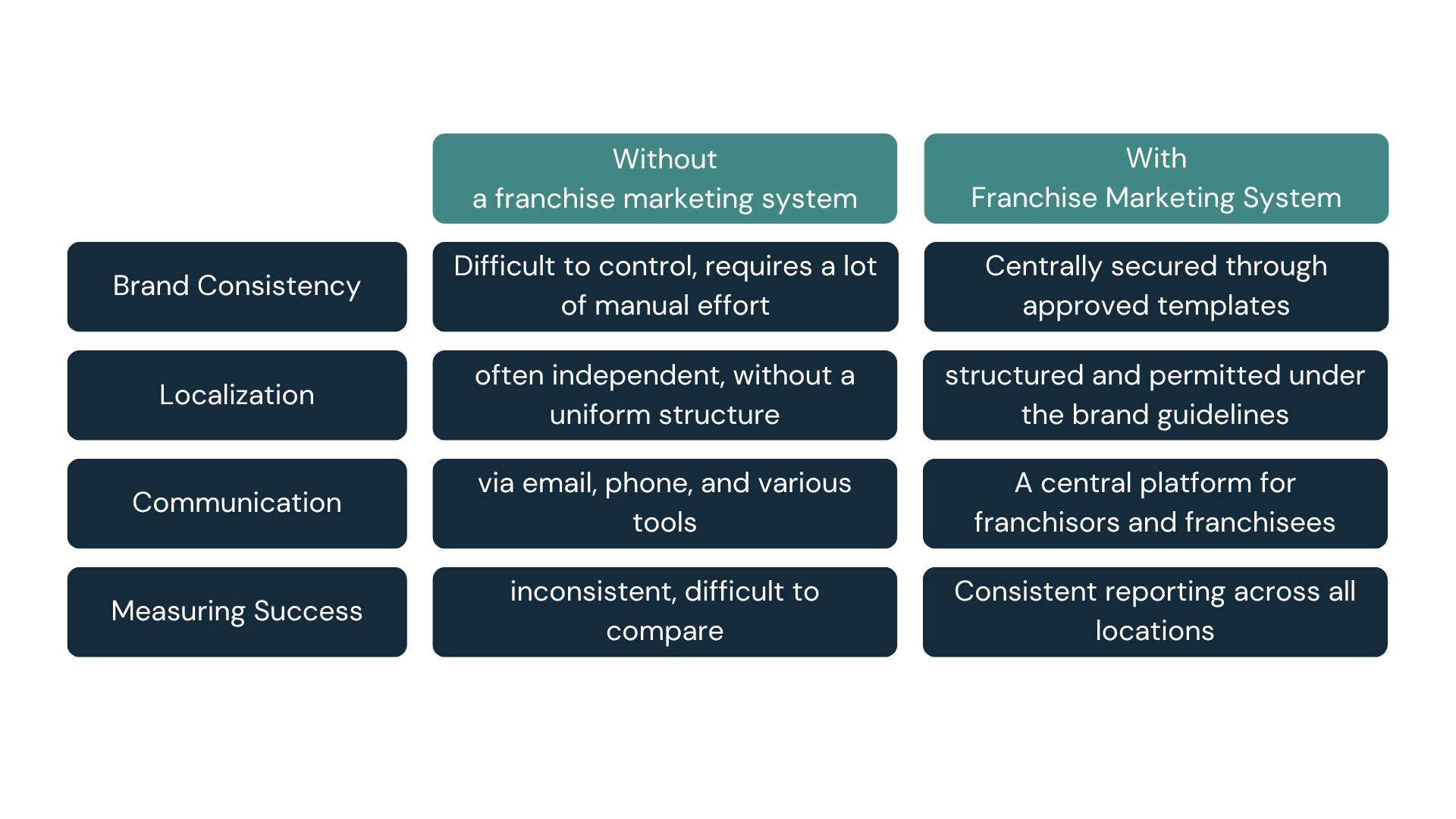
A well-implemented franchise marketing software contributes directly to the core goals of franchise marketing: a consistent brand image, more efficient collaboration, and measurably better results at every single location.
Unlock the full potential of your marketing
What is the difference between franchise marketing and traditional marketing?
Traditional marketing is usually managed by a single company for a single brand. Franchise marketing distributes this responsibility across two levels: the franchisor provides the central strategy and materials, while the franchisee implements them locally.
Who pays for marketing in a franchise: the franchisor or the franchisee?
This varies from one franchise system to another. Franchisees often pay a marketing or advertising fee to the franchisor, which is used for centralized campaigns, while local initiatives are additionally funded by the franchisees themselves. The exact breakdown should be specified in the franchise agreement.
What makes a successful franchise marketing system?
A good system combines centralized control with local flexibility: it provides materials centrally, allows for compliant local customization, offers clear approval processes, and delivers cross-location reporting.
How much freedom should franchisees have when it comes to localizing marketing materials?
As much as necessary, as little as possible for a consistent brand image. A clearly defined framework must be established by the franchisor. Elements that must remain unchanged could include, for example, the logo, color palette, and core message, while areas such as local offers, contact persons, or regional imagery can be customized.
What role does local search engine optimization (Local SEO) play in franchise marketing?
A key factor is that since many customers specifically search for offers nearby, a fully optimized Google Business Profile and location-specific content often directly determine whether a franchisee appears in local search results.